Fresh vs Frozen Fish: Choose for the Dish
- The short answer
- What does “fresh” versus “frozen” really tell you?
- How can you assess fresh fish at the counter?
- What should you inspect on frozen fish?
- Which format works better for the dish?
- How should timing influence the choice?
- How do you get either choice home safely?
- Does freezing change the food-safety rules?
- A practical fresh-versus-frozen checklist
- Sources
The short answer
Fresh fish is not automatically better than frozen fish. Choose the piece with the soundest handling history, the right cut for the dish, and a schedule you can actually keep. Well-packed fish that remains solidly frozen can be an excellent buy. Fresh fish makes sense when it is properly chilled, smells mild, feels firm, and will be cooked promptly. Condition matters more than the word on the case.
That answer also leaves room for a useful middle category: fish sold from the refrigerated case may have been previously frozen. That is not a defect. It simply means you should judge the fish in front of you and plan around the fact that it should not be casually refrozen at home.
What does “fresh” versus “frozen” really tell you?
The labels mainly describe the fish's current state and recent handling. They do not, by themselves, tell you when the fish was caught, how carefully it travelled, or whether it suits tonight's recipe.
NOAA Fisheries notes that fresh catch is often processed and frozen soon after it is caught, and calls frozen seafood a good choice. At the same time, a genuinely well-handled fresh fillet can offer exactly the shape, skin condition, and portion size you want. The useful comparison is therefore not “premium” against “second best.” It is one supply chain and cooking plan against another.
Ask three questions before looking at the price:
- Is this fish in sound condition now?
- Is this the cut, thickness, and skin-on or skinless format the dish needs?
- Can I keep it cold and cook it on the schedule its current state requires?
Those questions prevent an attractive display label from doing all the decision-making.
How can you assess fresh fish at the counter?
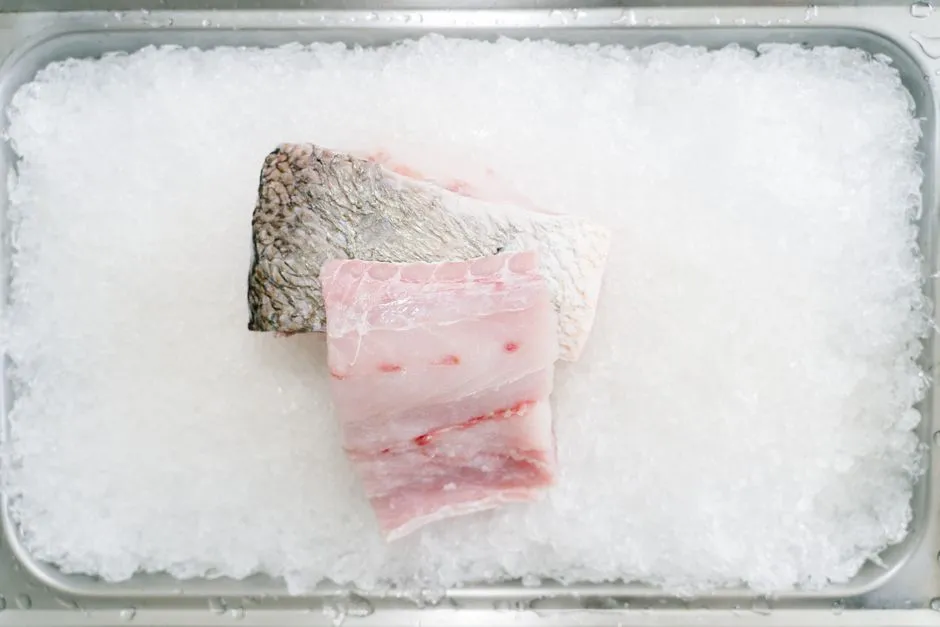
Start with temperature and display. The FDA says to buy fish only when it is refrigerated or displayed on a thick bed of fresh ice, preferably in a case or under cover. A fillet sitting warm is not rescued by a bright color or a handwritten catch description.
Then check the fish itself. FDA buying guidance says fish should smell fresh and mild, not fishy, sour, or ammonia-like. Fresh fillets should have firm flesh and no discoloration, darkening, or drying around the edges. For a whole fish, the agency points to clear, shiny eyes, firm flesh, and red gills without odor.
Do not use color as a freshness test on its own. The FDA explains that diet, environment, treatment, and packaging can affect color. A very pink fillet is not automatically a fresher one.
Fish marked “previously frozen” may not show every visual feature associated with fresh fish. The FDA specifically says it should still smell fresh and mild rather than fishy, sour, or rancid. NOAA likewise notes that a previously frozen fillet may look less shiny yet still be good to eat. Read that label as handling information, not as a verdict.
If the counter gives you no chance to inspect the package, ask when it was thawed and how the shop recommends storing it. A clear answer helps you fit the purchase into your meal plan; it does not extend the official storage window.
What should you inspect on frozen fish?
Frozen fish should feel unequivocally frozen. The FDA says the flesh should be hard and not bendable. It also advises against packages that are open, torn, or crushed at the edges, or that show frost or ice crystals. Those crystals may mean long storage or that the fish thawed and refroze.
NOAA adds several practical package checks: look for no liquid inside, no drying or discoloration, and no frost or ice particles. Fillets or steaks should be solidly frozen in the package. At a store display, avoid packages sitting above the freezer's frost line.
A little surface glaze deliberately applied around frozen fish is different from a loose drift of crystals inside a damaged package. If the label does not make that distinction clear, choose a cleaner, intact pack. You are buying the fish and the evidence of its handling together.
Individual vacuum packs can make portion planning simpler, but a neat pack is not a safety guarantee. Follow its storage and thawing directions, keep it frozen until you are ready to thaw it safely, and reject a leaking or damaged pack.
Which format works better for the dish?
Choose the physical cut before choosing a reputation. A recipe written for even salmon portions needs pieces of similar thickness whether they came from ice or a freezer. A whole-fish preparation needs an intact fish of the right size. A dish that will flake fish into a sauce can be more forgiving about an irregular edge than a plate built around a tidy fillet.
For baked salmon, matching portion thickness helps the pieces finish together. Frozen portions can be convenient when their size is visible through the package. Fresh portions let you inspect the cut directly. Neither advantage compensates for poor condition.
Texture planning begins after the purchase. Thaw frozen fish safely, drain away released liquid, and dry the surface with a clean paper towel before seasoning when the recipe calls for a dry exterior. Do not squeeze the fish or leave it out to hurry the process. With fresh fish, check for excess surface moisture and dry it just before preparation.
Skin-on cooking calls for a particularly careful look at the skin. Select a piece with intact skin and an even enough shape to lie flat in the pan or on the tray. For a sauced bake, stew, fish cake, or filling, exact appearance may matter less than sound odor, condition, and a cut appropriate to the method.
How should timing influence the choice?
Fresh fish gives you a near-term appointment. The FDA says that seafood intended for use within 2 days after purchase should be stored in a clean refrigerator at 40°F or below. Otherwise, it should be tightly wrapped in plastic, foil, or moisture-proof paper and put in the freezer. That is a safety boundary, not a promise that every fillet will remain at peak quality for the entire period.
Frozen fish gives you more control over which portions enter that short clock. If portions are separately packed, you can thaw only the number required for a meal. That can help avoid buying fresh fish for a vague plan and then feeling obliged to cook it before you are ready.
Fresh may be the more sensible purchase when dinner is firmly scheduled and the counter has the exact cut you need. Frozen may be more practical when plans shift, when you cook for one or two, or when a consistent portion size is useful. Previously frozen fish from the fresh case belongs on the fresh timetable once you bring it home; ask the seller for handling information instead of assuming it has a new lease on freezer life.
Buy only after the plan is real: dish, number of portions, cooking day, and safe route home. That simple order of decisions does more to prevent waste than choosing a format by habit.
How do you get either choice home safely?
NOAA recommends purchasing seafood last during a shopping trip and bringing a cooler for transport. At the store, keep raw fish separate from ready-to-eat food and other groceries that could be contaminated by a leak. At home, refrigerate or freeze it promptly according to the package and FDA storage guidance.
For frozen fish, protect the cold chain. The FDA warns that frozen seafood can spoil when it thaws during transport and remains warm too long before cooking. If a pack has softened substantially on the journey, do not invent a refreezing decision from its appearance; follow the package directions and current FDA guidance.
When it is time to thaw, use a method the FDA names: gradually in the refrigerator overnight; sealed in a plastic bag and immersed in cold water for quicker thawing; or in a microwave on defrost only when the fish will be cooked immediately, stopping while it is still icy but pliable. Do not thaw fish on the counter.
Does freezing change the food-safety rules?
No. Fresh and frozen fish both need safe handling and thorough cooking. Freezing does not kill all harmful germs, according to the FDA. This guide is for fish that will be cooked, not raw or undercooked preparations.
Keep raw fish away from ready-to-eat food. After handling raw food, the FDA says to wash hands with soap and warm water for at least 20 seconds. Wash boards, dishes, utensils, and counters with soap and hot water before they touch cooked or ready-to-eat food.
The FDA says most seafood should reach an internal temperature of 145°F. Use a food thermometer at the thickest part rather than treating fresh or frozen status as evidence of doneness. Our guide to how to tell when fish is done explains how to check the result without relying on color alone.
Raw or undercooked seafood carries parasite and bacterial risk. The FDA directs pregnant people, children, older adults, and people with weakened immune systems away from raw or undercooked fish and shellfish. No buying label removes that risk.
A practical fresh-versus-frozen checklist
Choose fresh or refrigerated fish when:
- it is properly iced or refrigerated;
- the odor is fresh and mild;
- the flesh and edges pass the FDA condition checks;
- the cut clearly suits the dish; and
- you will store and cook it within the official limits.
Choose frozen fish when:
- the package is intact and the fish is hard, not bendable;
- there is no suspicious frost, loose ice, liquid, drying, or discoloration;
- the portion size and cut fit the recipe;
- a flexible cooking date is genuinely useful; and
- you can keep it frozen and thaw it by an FDA-approved method.
Walk away from either when the condition is doubtful. “Fresh” cannot excuse a sour or ammonia-like odor, dry edges, or poor chilling. “Frozen” cannot excuse a torn pack, soft flesh, or evidence of thawing and refreezing.
The best buy is the fish whose condition you can assess, whose handling you can continue safely, and whose shape belongs in the dish you intend to cook.